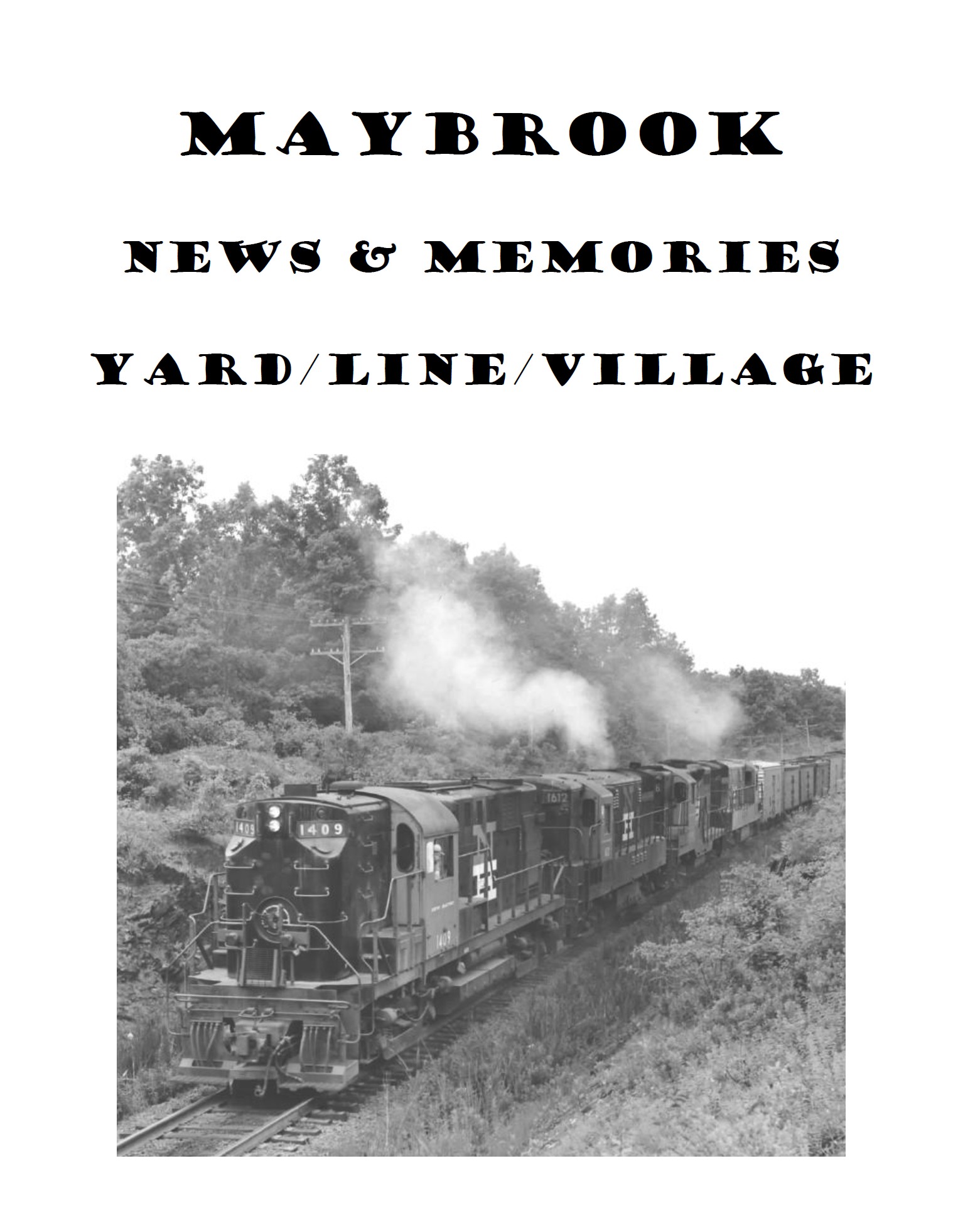
How was it to work in Maybrook Yard in its peak decades when dozens of trains from five carriers arrived and departed every day? When hump riders continually worked the eastbound and westbound humps, coasting cuts of cars, unaided and with only a hand brake, into the numerous classification tracks. When the yard sometimes resembled a “Wild West Scene” as thieves, both from the public and railroad worlds, preyed on the multitude of merchandise loads sitting in the yard before the days of Railway Express, UPS and FEDEX. When the hamlet of Maybrook suddenly became the hottest real estate site in Orange County and blossomed into a railroad town with no shortage of taverns and at least one house of ill repute. Land values skyrocketed as the New Haven was buying up farms to accommodate expansion of the yard. Businesses were being established and houses built. Gangs of Italian immigrants were brought in for various construction projects and some stayed to work on the railroad in entry level positions until the passage of years softened the prejudice toward them and they were allowed to advance to better positions.
Meanwhile, trains were arriving and departing and their crews were slowly building a lifetime of memorable experiences. Long careers out on the road inevitably included notable incidents, some humorous and others sobering for they involved wrecks and fatal accidents. A number of veterans relate experiences that have stayed with them over the decades. Late steam era and diesel era images accompany one New Haven veteran’s litany of experiences from Maybrook to Cedar Hill.
Previous books by the author have treated Maybrook as the “Gateway to Southern New England”. Accordingly, while Maybrook Yard received attention, the bulk of the coverage concerned the operations of the western connections, their western connections and the New Haven’s operations eastward. What was not covered was how it was to work in the yard or out on the road. Also not covered was the Village of Maybrook itself and how it developed alongside the yard. Then too, there was a quantity of fine steam and diesel images, covering a quarter-century from 1938 to 1964, that was not included in the first two books.
Over 150 newspaper articles recreate the world described in the first paragraph. They, and additional material, chronicle the history of Maybrook Yard from 1904, when the New Haven gained control of the embryonic yard’s owner, the Central New England Railroad, through May 8, 1974 when the Poughkeepsie Bridge suffered a fire that enabled Penn Central to finally close the bridge and the Maybrook Line, between Maybrook Yard and Cedar Hill Yard, in favor of its former New York Central line into New England via new Selkirk Yard. The articles relate how Maybrook Yard grew in the early decades and then declined in the later decades. Once the yard was partially developed and was handling considerable merchandise traffic it became a target for thieves, both outsiders as well as railroad employees. And sometimes the thieves outsmarted the railroad detectives.
Various aspects of Maybrook Yard are presented and include equipment that supported operations; several of the men who made the yard work and the all-important icing dock. Finally, there is photographic coverage of the late steam era switchers and road power and the diesels that replaced them in yard operations.
154 pages, soft cover, glossy paper, indexed, 75 black and white photographs including images from Robert
Collins, Gene Collora, Robert Pennisi and Pete McLachlan
